In short
The largest environmental impact of most corporate events is delegate travel, followed by food waste and single-use materials. The decisions that genuinely move the needle are choosing a destination close to where most delegates already are, reducing the number of flights, designing menus to cut waste, reusing set and exhibition structures, and eliminating printed collateral. Everything else is worth doing but secondary — and claiming otherwise is greenwashing.
Key takeaways
- Destination choice is the biggest lever, because travel usually dominates the footprint
- Reusable modular builds beat recyclable one-use builds every time
- Food waste is the most reducible impact and the one caterers can quantify with you
- Measure and report what you actually did; vague claims now attract scrutiny, not credit
Why this became a procurement question
Sustainability moved from a nice line in an event brief to a procurement requirement fairly quickly, and for an unromantic reason: larger companies now report on it. Listed Indian companies report sustainability information under regulatory frameworks, multinationals apply group-level reporting standards to their Indian operations, and many organisations have made public commitments that cascade into supplier questionnaires.
The practical effect for event planners is that someone will eventually ask what your event did and what it cost the environment, and a brochure phrase about being eco-friendly will not satisfy them. What satisfies them is a short list of specific decisions, with evidence.
That is also the healthiest way to approach it. Pick the three or four interventions that matter most for your particular event, do them properly, document them, and resist the temptation to claim more.
Where the footprint actually sits
For most corporate events, delegate travel dominates the environmental footprint, and the longer the flights and the larger the group, the more completely it dominates. Venue energy, catering, materials and waste are real but typically secondary. This matters because it means the most consequential decision is made at the very start, when the destination is chosen, and almost everything done afterwards is operating at the margins.
This is uncomfortable, because travel is also the part nobody wants to cut. But it reframes the choices usefully: a bamboo-and-jute set at a venue every delegate flew four hours to reach is a smaller intervention than holding the same event in the city where two-thirds of the group already lives.
If you only change one thing, change where the event is held. Everything else is a rounding error next to a plane full of delegates.
Travel: the decisions that matter
Start by mapping where delegates actually are before choosing where the event will be. The centre of gravity of your attendee list is frequently not the city your head office is in.
- Host in or near the city where the largest cluster of delegates lives — the three-hour rule that improves an offsite also cuts its footprint
- Favour rail over short domestic flights where the route is practical; several Indian corridors are genuinely competitive on door-to-door time
- Consolidate: one three-day national meeting usually beats four regional one-day meetings once travel is counted on both sides
- Use a virtual or hybrid layer deliberately to include people who would otherwise fly in for a half-day session. See hybrid and virtual event production
- Arrange coach transfers rather than individual cabs for airport runs, and plan arrival waves so vehicles run full
- Choose venues where accommodation, sessions and dining are on one site, which removes daily shuttle movements entirely
Venue and energy
Ask venues direct, answerable questions rather than whether they are sustainable. Do they have a renewable energy supply or on-site solar? Is there a documented waste segregation process and where does the waste actually go? What is their water source and do they treat and reuse it? Do they hold any third-party environmental certification, and can they show it?
Favour venues where your whole programme fits on one site, and where daylight reduces the lighting load in session rooms. Avoid building temporary structures when a permanent space would work — a marquee with its own power generation and climate control is one of the most energy-intensive choices available in Indian event production.
On generators: diesel backup is normal and often unavoidable, but the size and run time are negotiable. Specify what is genuinely needed rather than accepting a default, and ask whether the venue's grid supply can carry the load with a smaller standby.
Food: the most reducible impact
Catering is where good intentions meet the Indian hospitality instinct that a table should groan. Over-ordering is normal, waste is enormous, and it is also the easiest impact to reduce without anyone feeling short-changed.
Order to realistic consumption rather than to a comfort margin, using actual attendance rather than registrations. Fewer, better stations beat a sprawling buffet. Plated service at smaller headcounts controls portions far better than a buffet does. Build menus around seasonal, regionally sourced produce — which in India is both lower impact and better food. And make the vegetarian options the default rather than the alternative; in most Indian audiences this is uncontroversial and it meaningfully reduces the footprint of the catering line.
Then plan for the surplus before the event, not during the clear-down. Many hotels and caterers have existing relationships with food redistribution organisations; ask at contracting stage whether yours does and make it a condition. Agree who is responsible and get it in writing, because on the night nobody will have time to arrange it.
Materials, set and exhibition builds
The second-largest avoidable impact is stuff built once and thrown away. Indian event production is extremely good at fabricating things quickly and historically poor at reusing them.
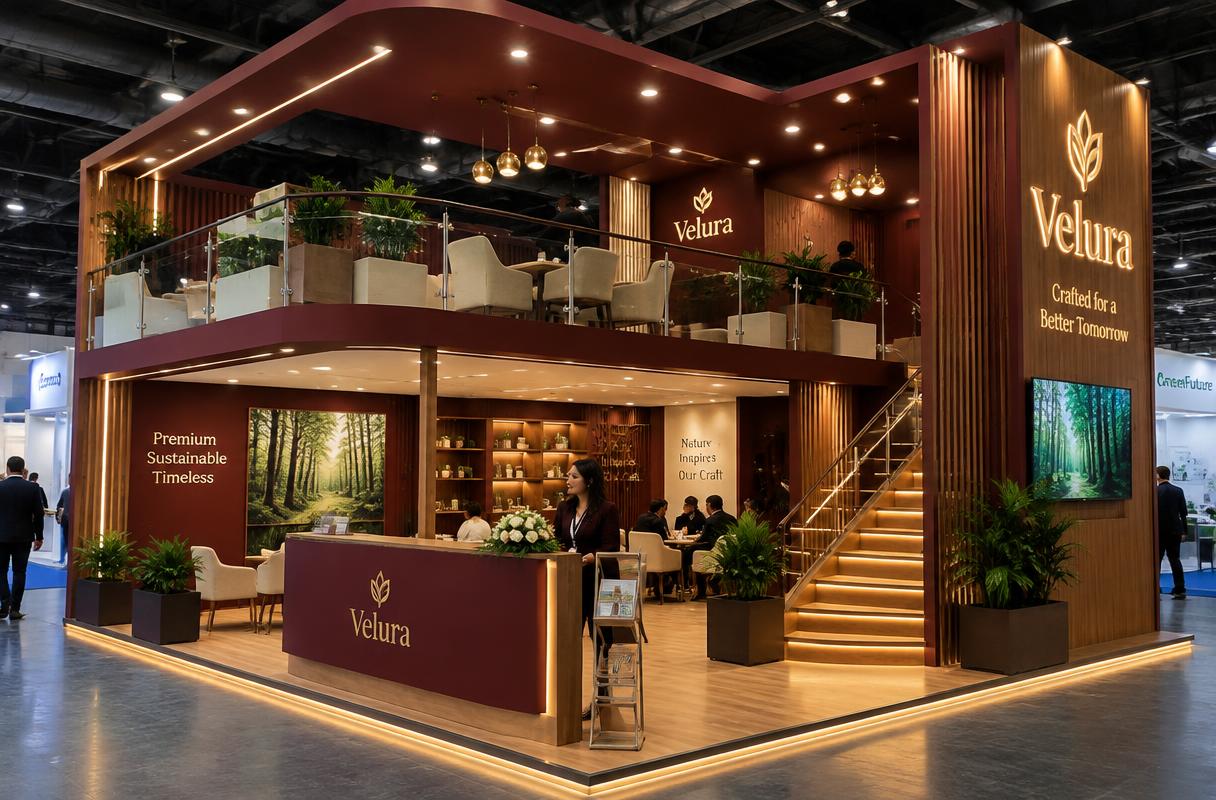
Design sets to be modular and dateless so elements return next year. For exhibitions, a reusable modular system beats a custom build scrapped after three days, and it usually wins on cost by the third show — we cover the trade-off in exhibition stall design. Avoid printing dates and venue names on anything structural, because that single decision determines whether a backdrop is reusable or waste.
Replace printed collateral with an event app or QR codes on signage. Badges are an easy win: use recyclable or reusable holders and collect them at the exit, which also helps you count actual attendance. Flooring, carpet and vinyl graphics are the three materials most often discarded after one use; ask your fabricator what the plan for each of them is.
India has prohibited a list of identified single-use plastic items, so compliant venues and caterers should already have alternatives in place. Verify rather than assume, and extend the principle: water in glass bottles or dispensers rather than individual plastic, no plastic stirrers, no individually wrapped anything.
Gifting
Delegate gifting generates more waste per rupee than any other line in an event budget, because most of it is unwanted. The branded bag containing a notebook, a pen, a water bottle and a sachet of something is a familiar sight in hotel bins the morning after.
Three approaches work better. Give one genuinely good thing instead of five forgettable ones — people keep quality and discard volume. Give something consumable and local: regional food, tea, coffee, a craft item from the destination, which supports local producers and leaves no residue. Or give nothing and make a contribution in the delegates' name to something relevant, communicated well enough that it does not read as a cost-saving.
If you do gift, skip the event date on it. A dated item has a single use; an undated one lives in someone's bag for years. See corporate gifting for options we curate.
Local sourcing and community impact
Sustainability is not only carbon. In India, where an event is held determines who earns from it, and routing spend locally is both lower impact and more defensible in a report.
Use local crews and local suppliers rather than flying a full team from a metro. Programme local artisans, performers and guides instead of generic entertainment — it is usually more memorable as well as more responsible. Source menus regionally. Where the programme includes a CSR element, choose something connected to the destination and structured with a genuine partner organisation, rather than a staged photo opportunity that consumes a morning and helps nobody.
Accessibility belongs in this conversation too. Step-free routes, legible signage, captioning on recorded content, quiet spaces and dietary accommodation are social sustainability, and they are increasingly asked about in the same supplier questionnaires.
Measure it, then report it honestly
Decide at the briefing stage what you will measure, because you cannot collect it retrospectively. Useful, obtainable numbers include delegate travel by mode and distance, venue energy consumption for your event if the venue can isolate it, meals served against meals ordered, surplus food redistributed, waste segregated by stream, and the proportion of set and structure reused from a previous event.
Report what you did and what you did not. A wrap report that says travel was the dominant impact, we reduced it by hosting in Pune rather than Goa, we redistributed surplus from three services, and we reused the main set from last year is far more credible than a page of leaf icons. Specificity is the whole currency here.
And avoid the claims that invite challenge. Carbon neutral, net zero and fully sustainable are strong statements with technical meanings. If you have not done the work to support them, describe the actions instead — nobody has ever been criticised for understating.
Impact versus effort
| Intervention | Impact | Effort | Notes |
|---|---|---|---|
| Choose a destination near the delegate cluster | High | Low | The single biggest lever available |
| Replace a regional roadshow with one consolidated event | High | Medium | Cuts total travel across the year |
| Add a virtual layer for part-day attendees | High | Medium | Works best when designed in, not bolted on |
| Order catering to realistic consumption | Medium | Low | Also the easiest cost saving in the budget |
| Arrange surplus food redistribution | Medium | Low | Contract it with the venue in advance |
| Reusable modular set and stand | Medium | Medium | Pays back financially from roughly the third use |
| Remove printed collateral | Low | Low | Visible, easy and appreciated by delegates |
| Local sourcing of food, crew and talent | Medium | Low | Improves the event as well as the footprint |
Planning something like this?
Tell us the brief, get an itemised proposal
Share your dates, group size and destination. You will get a costed, line-by-line proposal from our planning team within 24 hours — with taxes shown separately.
Frequently asked questions
Delegate travel, in most cases by a wide margin, and especially where long-haul or multiple domestic flights are involved. Venue energy, catering and materials are real but usually secondary, which makes destination choice the most consequential decision you make.
Lower-impact formats
Destinations that cut travel
Drive-distance options from India's largest corporate clusters.