In short
Plan a corporate offsite by fixing the objective first, choosing a destination within roughly three hours of where most of the group lives, and building an agenda that is about half structured content, a quarter team activity and a quarter deliberate downtime. Lock the venue eight to twelve weeks out, budget ₹12,000–50,000 per person for a residential programme in a tier 1 market, and assign one owner for every element of the run of show.
Key takeaways
- One objective. Two at most. An offsite that tries to do four things does none of them
- Travel time is programme time — the three-hour rule protects more value than any venue upgrade
- Roughly 50% content, 25% team activity, 25% genuine downtime
- Decisions made at an offsite evaporate without a named owner and a date
Step 1: Decide what the offsite is actually for
Almost every disappointing offsite can be traced back to an unwritten objective. The invitation says team offsite, everyone turns up with a private expectation — the leadership team wants strategy, the managers want clarity, the team wants a break — and the agenda quietly tries to satisfy all three. Nobody leaves unhappy, but nothing changes either.
Write the objective as a single sentence that starts with a verb and names an outcome. Align the leadership team on next year's three priorities. Rebuild trust between two functions that merged in March. Reward a quarter that exceeded target. Those three sentences produce three completely different events, in three different places, at three different price points.
The four common offsite objectives
In practice, corporate offsites in India fall into four recognisable types, and naming yours early makes every later decision easier.
- Strategy — small group, long working sessions, quiet venue, minimal distraction. Hill resorts and standalone properties work best
- Alignment — mid-sized, mixed content and interaction, usually after a reorganisation or a new plan
- Team building — activity-led, facilitated, deliberately uncomfortable in small ways. See team building activities
- Reward and celebration — closer to an incentive trip than to a working offsite, and should be budgeted as one
Step 2: Choose the destination — the three-hour rule
Keep the destination within about three hours door to door from where the majority of the group lives. This single constraint buys back more value than almost any other decision. A two-night offsite three hours away gives you two full working days; the same two nights six hours away gives you one and a half, plus a group that arrives tired and leaves early.
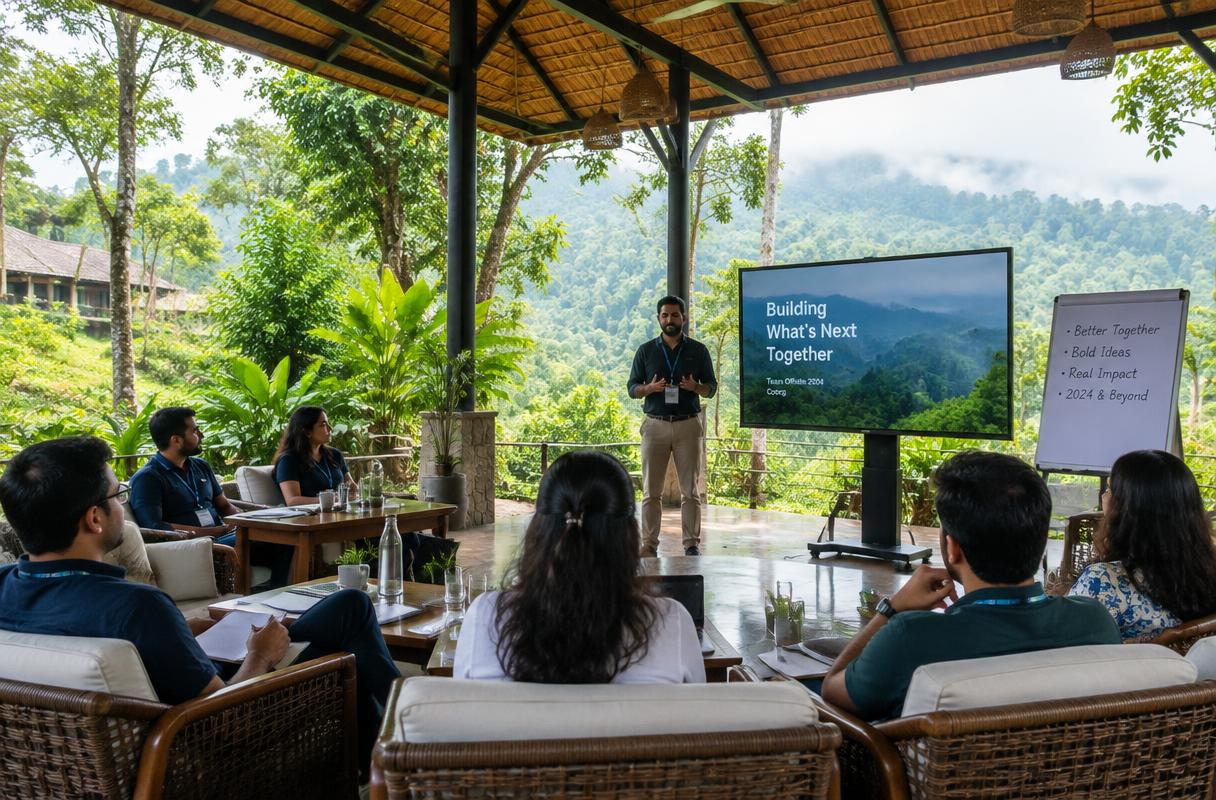
That usually means a drive-distance destination. Mumbai and Pune teams go to Lonavala, Alibaug, Mahabaleshwar or Nashik. Delhi NCR teams go to Jim Corbett, Rishikesh, Neemrana or the Aravalli belt. Bengaluru teams go to Coorg, Chikmagalur or Mysuru. Hyderabad and Chennai teams fly short or drive to the nearest resort belt. Our Coorg, Lonavala and Rishikesh pages list the properties we use most.
Flying is justified when the destination is itself part of the reward, or when the group is already distributed across cities and everyone has to fly anyway. In that case Goa and Jaipur are the usual answers, because they are well connected from everywhere and nobody has to be the person with the bad flight.
Every extra hour of travel costs you roughly two hours of programme — the hour itself, and the hour of energy it takes out of the room.
Step 3: Design the agenda before you book anything
The agenda determines the venue, not the other way round. Six breakout groups need six breakout spaces; a full-day strategy session needs daylight and a room that can be rearranged; a campfire conversation needs an outdoor space that works after dark and a wet-weather alternative.
A proportion that works for most two-night offsites is roughly half structured content, a quarter team activity and a quarter genuine downtime. The downtime is not padding. It is where the conversations happen that the agenda cannot schedule, and it is the first thing cut by planners who feel guilty about the budget.
Content sessions
Keep sessions to 90 minutes maximum with real breaks between them. Put anything requiring hard thinking before lunch; after lunch, the room can discuss but it cannot decide. If you have an external facilitator, brief them on the objective rather than the agenda and let them design backwards.
Team activity
Choose activities that create mild, shared difficulty rather than enforced fun. Cooking challenges, outbound problem-solving, a CSR build, a treasure hunt through an old city quarter — all of these work because the group has to coordinate. Avoid anything that embarrasses people in front of their manager, and always offer a genuine non-physical alternative.
Downtime and the one signature moment
Build the programme around a single moment people will describe afterwards: a dinner inside a fort, a sunrise on the Ganga, a boat transfer to an island, a private performance. One well-executed moment beats three competent ones, and it costs less than spreading the same budget across every evening.
Step 4: Select the venue
Shortlist three properties and inspect at least the leading one. The things that decide an offsite venue are rarely the things in the brochure.
- Can the whole group sleep on one property? Splitting across two hotels costs you the informal hours entirely
- Does the main session room have natural light and a ceiling that will take a projection throw?
- How many genuinely separate breakout spaces exist — not corners of the same hall?
- Is there an outdoor space that works after dark, and a covered fallback if it rains?
- Does the kitchen handle dietary requirements properly, including Jain, vegan and allergen-specific meals?
- Is connectivity good enough for a hybrid joiner, and is there a wired option for the session room?
- What is the attrition clause, and what is the cut-off date for releasing unsold rooms?
Step 5: Budget realistically
As an indicative benchmark, a residential corporate offsite in a tier 1 market runs ₹12,000–50,000 per person for the whole programme, with tier 2 destinations around 15% lower. The spread reflects hotel category more than anything else — the same agenda at a four-star resort and at a luxury property can differ by a factor of three.
Where the money actually goes, for a typical two-night programme: accommodation and food usually take 55–65%, activities and facilitation 10–20%, transport 5–15%, audiovisual and meeting setup 5–10%, and gifting, photography and contingency the remainder. Keep 10% genuinely unallocated. Something always comes up, and the alternative is an awkward conversation about an overrun that was entirely predictable.
For a line-by-line breakdown of what drives the number, see our corporate event budget guide.
Step 6: Run the days properly
Build a run of show with a named owner against every line — not a department, a person. Who opens the room at 09:00? Who has the laptop with the deck? Who handles the delegate whose bag did not arrive? On the day, the planner should be the person with nothing specific to do, because that is the only way to absorb the things nobody planned for.
Two small habits make a disproportionate difference. First, do a technical walk-through the evening before, with the actual laptop and the actual deck. Second, start on time on day one even if people are missing. The group learns within the first hour whether this offsite is a serious use of their time, and that impression is very hard to reverse.
Step 7: Make the decisions survive the journey home
The commonest failure of an otherwise excellent offsite is that nothing happens afterwards. Before the group leaves the room on the final day, convert every conclusion into an owner, a date and a single success measure. Photograph the flip charts, circulate them within 24 hours while the language still means something, and put a 30-day review in the diary before anyone reaches the airport.
Send a short feedback form within 48 hours — five questions, not twenty — and ask one open question about what should be different next time. That answer, collected consistently, is what turns an annual offsite into a programme that improves.
A two-night offsite skeleton
| Time | Day 1 | Day 2 | Day 3 |
|---|---|---|---|
| Morning | Travel and arrival, late check-in | Opening session, then two working blocks | Closing session: owners, dates, measures |
| Midday | Lunch and settle in | Lunch outdoors if the weather allows | Lunch and departure |
| Afternoon | Opening context session, 90 minutes | Team activity or facilitated offsite exercise | Travel home |
| Evening | Informal dinner, no agenda | The signature moment: themed dinner or private experience | — |
Two nights is the sweet spot for a working offsite. Three nights needs a reward element to justify the time away; one night rarely clears the travel overhead.
Planning something like this?
Tell us the brief, get an itemised proposal
Share your dates, group size and destination. You will get a costed, line-by-line proposal from our planning team within 24 hours — with taxes shown separately.
Frequently asked questions
Two nights and three days suits most working offsites. One night is usually swallowed by travel and arrival logistics, and three nights needs a reward or celebration element to justify the time out of the business.
Offsite destinations by home city
Drive-distance options that respect the three-hour rule.